

We often hear about PM2.5, PM10, aerosols, nitrogen dioxide and ozone whenever air pollution makes headlines. But what do these terms actually mean? What are we breathing, where do these pollutants come from, and why are some of them so harmful to our health?
Every winter, smog becomes a familiar concern across Pakistan. Cities are covered in haze, visibility drops, schools and outdoor activities are affected, and people are advised to limit their exposure to polluted air.
But air pollution is not just what we see in the sky. Much of what makes the air unhealthy is invisible to the naked eye.
The problem is a mixture of tiny particles and gases released by vehicles, industries, power plants, brick kilns, burning fuels, agricultural activities and other sources. Some pollutants are emitted directly, while others are formed in the atmosphere through chemical reactions.
To understand the smog crisis, we first need to understand what is actually present in the air we breathe.
What is particulate matter (PM)?
Particulate matter, commonly known as PM, refers to a mixture of tiny solid particles and liquid droplets suspended in the air. These can include dust, smoke, soot, ash, chemical particles and other microscopic material. They come from both natural sources and human activities.
Not all particles are the same size, and their size matters because it determines how deeply they can travel into our respiratory system. This is why air-quality monitoring commonly focuses on two categories: PM10 and PM2.5.
PM10: The larger particles
PM10 refers to particles with a diameter of 10 micrometres or smaller. These are often associated with dust and other coarse particles.
- Road and construction dust
- Soil and wind-blown dust
- Mining and industrial activities
- Agricultural operations
- Pollen and other biological material
These particles can enter our respiratory system and irritate the nose, throat and airways. They can also worsen existing respiratory conditions.
PM2.5: The fine particles we need to worry about
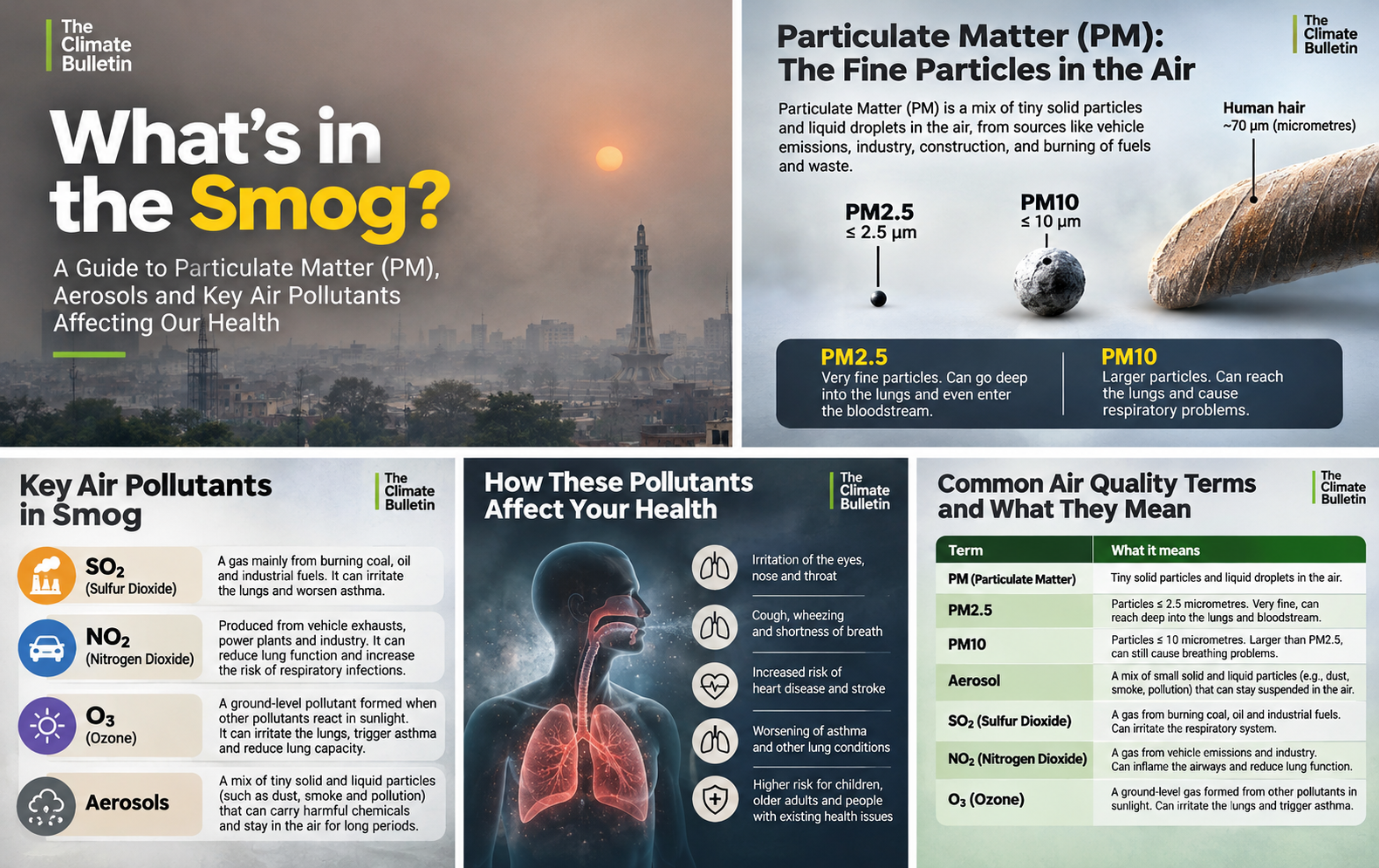
PM2.5 refers to particles with a diameter of 2.5 micrometres or smaller. To understand how small they are, consider that an average human hair is around 70 micrometres thick. A PM2.5 particle is roughly 1/30th of that width.
These particles are produced by sources such as vehicle exhaust, industrial emissions, diesel generators, brick kilns, burning coal and other fuels, crop-residue burning and open waste burning. They can also form in the atmosphere when gases react with one another.
What makes PM2.5 particularly concerning is its ability to travel deep into the lungs. Some components of fine particulate pollution can enter the bloodstream. Long-term exposure is associated with serious respiratory and cardiovascular problems, including asthma, reduced lung function, heart disease and stroke.
This is why PM2.5 is one of the most important pollutants to monitor when assessing the health impact of air pollution.
An important distinction: PM10 means particles 10 micrometres or smaller. PM2.5 means particles 2.5 micrometres or smaller. PM2.5 is part of the PM10 category. PM2.10 is not a standard air-quality measurement.
What are aerosols?
Aerosols are tiny solid particles or liquid droplets suspended in the atmosphere. Dust, smoke, soot, sea salt and certain chemical particles are all examples of atmospheric aerosols.
They are important because they affect both air quality and the climate. Some aerosols can carry harmful substances into our respiratory system. Others absorb or scatter sunlight and influence cloud formation.
For example, black carbon, commonly known as soot, absorbs sunlight and contributes to atmospheric warming. Other particles can scatter sunlight and have a cooling effect. The impact depends on the type of aerosol, its composition and where it is present in the atmosphere.
The other pollutants: SO₂, NO₂ and O₃
Particulate matter is only one part of the air pollution problem. Several gases also affect the quality of the air we breathe and contribute to the formation of smog.
1. Sulphur dioxide (SO₂)
Sulphur dioxide is a gas mainly released when fuels containing sulphur, such as coal and certain types of oil, are burned. Major sources include power plants, industrial boilers, factories and other fuel-burning activities.
It can irritate the respiratory system and worsen asthma. In the atmosphere, SO₂ can also react with other substances to form sulphate particles, which contribute to PM2.5. This means a gas released from an industrial source can eventually become part of the fine particulate pollution we breathe.
2. Nitrogen dioxide (NO₂)
Nitrogen dioxide is mainly produced during high-temperature combustion. Vehicle engines, power plants, generators and industrial activities are important sources.
It can irritate the airways, worsen asthma and affect lung function. NO₂ is also involved in atmospheric reactions that produce ground-level ozone and secondary particulate matter. This is one reason traffic emissions are such an important part of the urban air pollution problem.
3. Ground-level ozone (O₃)
Ozone is a gas made up of three oxygen atoms. But its impact depends on where it is found. High in the atmosphere, the ozone layer protects us from harmful ultraviolet radiation. Near the ground, however, ozone is a harmful air pollutant.
Ground-level ozone forms when nitrogen oxides and volatile organic compounds react in the presence of sunlight. It is therefore not simply emitted directly from vehicle exhaust or factory chimneys.
It can cause coughing, throat irritation, breathing difficulties and worsen asthma. It can also damage crops and vegetation.
4. Carbon monoxide (CO)
Carbon monoxide is a colourless and odourless gas produced by incomplete combustion of fuels. Vehicle exhaust, generators, fires and poorly ventilated fuel-burning appliances are among its sources.
It is particularly dangerous because it reduces the blood’s ability to carry oxygen. High concentrations can cause serious poisoning and can be fatal.
5. Volatile organic compounds (VOCs)
VOCs are a large group of chemicals that easily evaporate into the air. They can come from fuels, paints, solvents, industrial processes and vehicle emissions. Some are harmful on their own, while others react with nitrogen oxides in sunlight and contribute to ground-level ozone and photochemical smog.
6. Ammonia (NH₃)
Ammonia is an important agricultural emission. It can be released from livestock waste, manure and fertiliser use. In the atmosphere, it reacts with other compounds to form fine particles such as ammonium nitrate and ammonium sulphate. These contribute to PM2.5.
This also shows why air pollution is not only an urban transport or industrial issue. Agricultural activities can contribute to the problem too.
How do these pollutants create smog?
Smog is not a single pollutant. It is a mixture of particles, gases and atmospheric conditions that can reduce visibility and affect human health.
Vehicles, industries, power plants, brick kilns, generators, agricultural burning and waste burning release pollutants into the atmosphere. Some particles are emitted directly. Others form when gases such as sulphur dioxide, nitrogen oxides, ammonia and VOCs react with one another.
Weather conditions then determine how quickly these pollutants disperse. During certain winter conditions, a temperature inversion can develop. A layer of warmer air sits above cooler air near the ground, restricting the upward movement of air and trapping pollution close to the surface.
When winds are weak and the atmosphere is not mixing properly, pollutants can accumulate and air quality can deteriorate. This is one reason smog episodes can become particularly severe in winter.
Why is this important for Pakistan?
Pakistan’s air pollution challenge is not limited to Lahore or one particular season. Transport emissions, industrial activity, brick kilns, power generation, construction dust, crop-residue burning, waste burning and household fuels can all contribute to poor air quality.
Their contribution varies from city to city and from season to season. There is no single source responsible for every smog episode.
It is also important to understand that pollution travels. Air does not follow administrative boundaries, and pollutants can move between regions depending on wind and weather conditions.
We need better monitoring, reliable data and a clearer understanding of the sources behind pollution in different parts of the country. Without knowing what is in the air and where it is coming from, it becomes difficult to develop effective solutions.
What does the Air Quality Index (AQI) tell us?
The Air Quality Index, or AQI, is a tool used to communicate how polluted the air is and what that may mean for public health.
Monitoring systems measure pollutants such as PM2.5, PM10, ozone, nitrogen dioxide, sulphur dioxide and carbon monoxide. The readings are then used to calculate an AQI category or value. Different countries and platforms may use different AQI systems, so it is important to check which standard is being followed.
A single AQI number can also hide differences between pollutants. When available, it is useful to look at the individual PM2.5 and PM10 readings as well.
What can we do when air quality deteriorates?
Individual precautions cannot solve the wider air pollution crisis, but they can help reduce exposure.
- Check reliable local air-quality readings before outdoor activities.
- Avoid prolonged or strenuous outdoor exercise during severe pollution episodes.
- Use a well-fitting N95 or equivalent respirator when appropriate during high particle pollution.
- Keep indoor air as clean as possible and consider a suitable HEPA air purifier.
- Avoid burning waste and other materials.
- Follow public-health advice, especially for children, older adults and people with existing respiratory or heart conditions.
It is important to remember that masks designed to filter particles do not protect against every gaseous pollutant. The real solution is to reduce pollution at its source.
Clean air requires more than emergency measures
We cannot continue treating smog as a seasonal inconvenience that disappears when the weather changes.
Cleaner transport, effective industrial emission controls, better fuel quality, improved brick-kiln technology, alternatives to crop-residue burning, proper waste management and stronger air-quality monitoring all need to be part of the response. Agricultural emissions and construction dust also deserve attention.
Most importantly, air-quality information should be accessible and transparent. People have a right to know what they are breathing, where pollution is coming from and what is being done about it.
The first step towards addressing an environmental problem is understanding it. PM2.5, PM10, aerosols, sulphur dioxide, nitrogen dioxide and ozone may sound like technical terms, but they are directly connected to our everyday lives.
The air we breathe affects our health, our children, our environment and the future of our cities.
Clean air should not be a privilege. It is a basic requirement for a healthy society.
Further reading and scientific sources
- World Health Organization — Ambient (outdoor) air pollution
- World Health Organization — WHO Global Air Quality Guidelines
- US Environmental Protection Agency — Particulate Matter (PM) Pollution
- US Environmental Protection Agency — Ground-level Ozone
This article is an educational explainer. Actual air quality and exposure vary by location, weather and time.